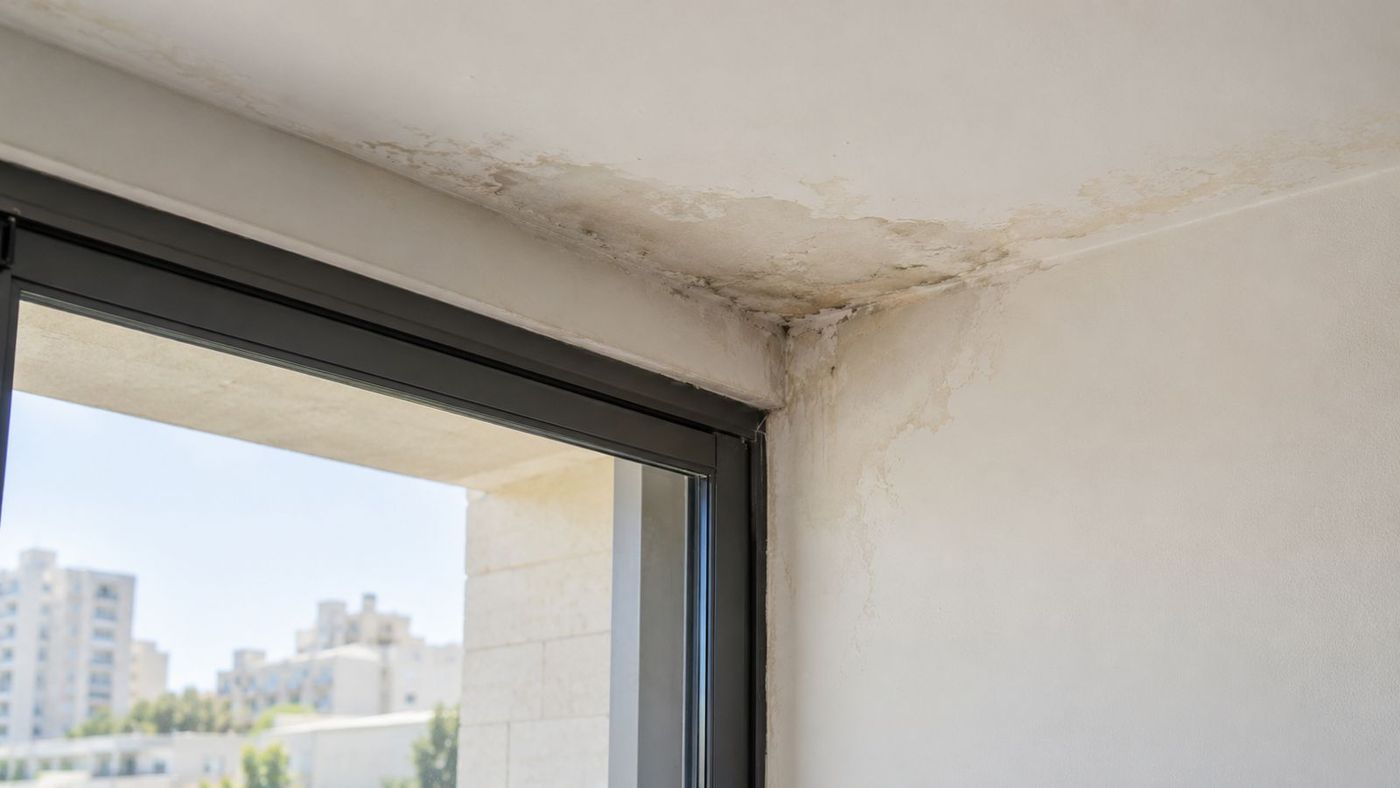
An owner whose flat was damaged by moisture seeping from the flat above, and which has stood empty since March 2023, sued the neighbour and his liability insurer for about ILS 423,000, mostly for lost rent. The court partly allowed the claim: it awarded rent from the time the flat was vacated until the date of the decision plus repair costs, and rejected the claims for municipal tax, income tax, a replacement wardrobe and a repair order.
What happened
The claimant owns a rented flat on the first floor of an old building in Ramat Gan. In early December 2022 the tenant reported moisture in several rooms and plaster falling in the bedroom. The owner contacted the upstairs neighbour in dozens of messages and calls, and a plumber he sent found that the water came from the neighbour's flat. The neighbour referred him to his liability insurer, which replied that it does not send tradespeople and asked for a quote.
When the lease ended at the end of February 2023, the tenant refused to renew it because of the moisture and left. The flat has been empty ever since. The owner paid ILS 12,900 for two rounds of repairs, in April and October 2023, after the neighbour said the problem on his side had been fixed, but the moisture came back each time. The insurer agreed to pay only ILS 1,755.
The claim was for ILS 423,054, including ILS 327,800 in lost rent from March 2023 to the end of 2027, plus repair costs, municipal tax (arnona) and bills, income tax and the replacement of a built-in wardrobe.
Who is responsible for the moisture
The neighbour and his insurer argued that the moisture came from the building's age, from rainwater entering through cracks and from the owner's own neglect, and that their inspections found no active leak. The engineer appointed by the court found six defects in the neighbour's flat, including a cracked and rusted bathtub, a drain connection that had come apart, an inspection box sealed with concrete and a broken pipe on the balcony, with a full match between their location and the damaged spots below. On a second visit he found that the defects had not been repaired and that the ceilings still showed about 20% moisture.
The court adopted the expert's opinion. It explained that the absence of an active leak proves nothing, because the moisture stays trapped in the concrete, and noted that the defendants' own reports supported the same conclusion. The neighbour even admitted under cross-examination that the pipes in his flat were rotten. Only the moisture on the south balcony and in the kitchen was excluded from his responsibility. The neighbour and the insurer are therefore jointly and severally liable. The court also remarked that it was improper to show the expert new reports for the first time during cross-examination.
Should the owner have rented the flat out anyway?
The defendants argued that the owner failed to mitigate his loss by leaving a flat in Ramat Gan empty for more than three years, and that it did not meet the definition of a flat unfit for habitation in the Rental and Loan Law. The court rejected these arguments. The expert found that the flat had been unfit for habitation since March 2023, and even if it had been possible to live there, an owner cannot be expected to rent out a flat with falling plaster where mould is to be expected. Only the neighbour could carry out the repair, and the owner acted reasonably. The definition in the Rental Law governs relations between landlord and tenant, not this question.
The insurer also relied on sections 61, 65 and 67 of the Insurance Contract Law. The court made clear that the duty to mitigate under that law rests on the insured, meaning the neighbour, and not on the injured third party. The delay argument was also rejected, because an earlier leak in 2019 had been repaired and the current damage appeared in December 2022.
What was awarded
- Repairs: ILS 12,900 for repairs already done and ILS 6,000 for future repair, plus VAT, ILS 19,980 in total.
- Rent: from March 2023 until the date of the decision, based on a valuation by an appraiser the owner hired: ILS 5,300 a month in 2023, ILS 5,550 in 2024 and ILS 5,800 in 2025 and 2026, plus interest. The valuation was accepted even though the appraiser is a relative, because no counter-valuation was filed. No compensation was awarded up to the end of 2027, because the defect may be repaired before then.
- Building fees, water and electricity: ILS 2,908.
- Rejected: municipal tax, because the owner could have asked the municipality for an exemption under section 330(1) of the Municipalities Ordinance for a damaged, uninhabitable property; income tax, which would have been paid out of the rent anyway; and the wardrobe, which was found to be in good condition.
- Repair order: rejected, because it was first requested in closing submissions and it is doubtful that the Magistrates' Court has power to grant it. The owner may seek a repair order in separate proceedings.
The ILS 1,755 already paid is to be deducted. The defendants will also pay the owner's costs against receipts, legal fees of 23.6% of the amount awarded, and an extra ILS 3,000 for attaching new evidence to their submissions without permission. Since the final sum has not yet been calculated, the decision will be completed by a final judgment with the figures, which can be appealed to the District Court within 60 days of its signing.
Key takeaways
- Found moisture coming from a neighbour's flat? Document everything: messages, photos and a professional report on where the water comes from.
- A flat made unfit to live in by a defect in the neighbour's flat may entitle you to compensation for rent for the whole period it stood empty.
- Is your empty flat too damaged to live in? Notify the municipality in writing and ask for a municipal tax exemption, or you may not recover that amount from the party at fault.
- An insurer's argument that you failed to mitigate under the Insurance Contract Law is aimed at its own insured, not at you as an injured third party.
- If you want the court to order the neighbour to repair, ask for it in the statement of claim and check which court can grant it.
This article summarizes a published Israeli court decision in plain language and is not legal advice. Every case depends on its facts. The parties' names have been omitted. This is a first-instance decision and may be appealed.