
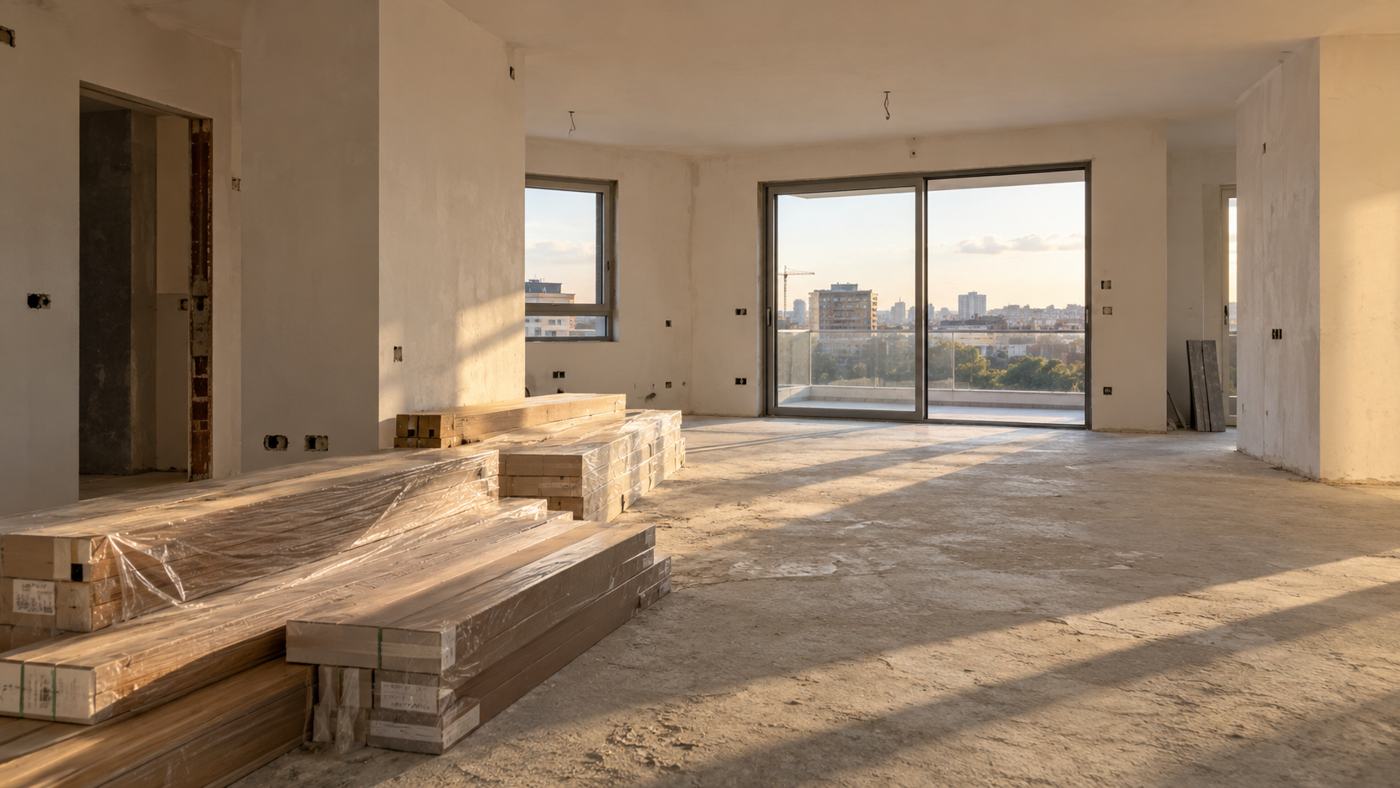
The buyer of two new apartments sued the developer over a 33-month handover delay and loss of value, and the developer counterclaimed for the balance of the price. The court rejected all of the developer's excuses and awarded the buyer ILS 321,823, but ordered her to pay ILS 316,521 as the balance of the price, so that in the end she received only ILS 5,302.
What happened
In February 2019, a new immigrant from France bought two three-room apartments in a new project in Netanya, for ILS 1,550,000 each. Under the contracts, the apartments were to be handed over on 22.7.2020. In fact they were handed over only on 20.4.2023, 33 months late. In the meantime the developer had paid her partial compensation of ILS 142,800.
The buyer sued for the rest of the delay compensation and also for loss of value, arguing that the developer had shrunk the lobby and changed the building contrary to what was promised. The developer filed a counterclaim, arguing that she had not paid the full price and had paid late.
The developer's excuses rejected
Because the contracts were signed in 2019, the version of the Sale (Apartments) Law in force before Amendment 9 applied. Under section 5A of the law, once the delay exceeds 60 days the buyer is entitled to compensation without proving any loss, based on the rent of a comparable apartment multiplied by 1.5 for the first eight months and by 1.25 from the ninth month onward. This provision protects the buyer and cannot be waived to the buyer's detriment. The court stressed that the burden of proving that a delay was caused by something outside the developer's control lies on the developer.
- COVID: the developer relied on an affidavit from its manager and on a recommendation from the Ministry of Housing. The court held that the word "COVID" alone does not justify a delay, and that the developer should have produced site work logs showing how many working days were actually lost. No such logs were filed. The Ministry's recommendation is only a recommendation and is not binding.
- Shortage of workers and materials, delays by the authorities and the electricity company, suppliers: these are ordinary risks for anyone running a building project. If an outside party caused the developer harm, it can sue that party, but this does not release it from its obligations to the buyer. Beyond that, the developer presented almost no documents proving any delay, and did not call the parties it blamed as witnesses.
- Changes ordered by the buyer: the developer argued that the buyer's alterations added about 45 days. The court held that no link between the changes and the delay was shown, and that such a period is swallowed up within such a long delay.
- "The buyer frustrated the handover": the evidence showed the opposite. The buyer and her father pressed the developer to hand over the apartments, and it was the developer that cancelled the meetings.
What the buyer was awarded
According to the expert appointed by the court, the fair rent was ILS 4,956 and ILS 4,885 a month for the two apartments. The statutory calculation put the compensation at ILS 425,623; after deducting the ILS 142,800 already paid, ILS 282,823 remained.
On loss of value, the buyer's appraiser estimated the damage at ILS 237,000 per apartment. The court adopted the opinion of its own expert, who found harm only in the reduction of the lobby area, and awarded ILS 39,000. Other changes, such as the location of the entrances or the addition of commercial space, fell within the discretion that the contract and technical specification gave the developer. A claim for further compensation for "fundamental breach" was rejected, because the statutory multiplier is meant to cover all the harm caused by the delay, and the same harm is not compensated twice. In total the buyer was awarded ILS 321,823.
The counterclaim: the balance of the price
The dispute was whether the payment dates in the contract were measured from the contractual handover date or from the actual handover date. The court held that because the developer drafted the contract, any doubt in its interpretation works against it (section 25B1 of the Contracts (General Part) Law). It also noted that for years the developer never demanded in writing the payments it now said were overdue, and even handed over the apartments. The buyer was therefore found not to have paid late, and was not ordered to pay late-payment interest or agreed compensation. However, her claim that it had been agreed she would be exempt from index linkage in return for paying early was not proven, partly because the lawyer who represented her in the purchase did not testify. She was ordered to pay ILS 316,521 as the balance of the price, based on the court-appointed accountant's opinion.
The outcome
After setting the two amounts off against each other, the developer was ordered to pay the buyer only ILS 5,302, plus interest from the date the claim was filed, with each side bearing its own costs. The court remarked that the case had lasted more than three years, mainly because the buyer had added a complex loss-of-value claim to her delay claim. This is a first-instance judgment and can be appealed.
Key takeaways
- A developer that hands over late must prove with documents, such as site work logs, that the delay came from something outside its control. A general claim about COVID or authority delays is not enough.
- A contract clause that exempts the developer from paying for delays caused by "force majeure" or the authorities does not override the compensation set by the Sale (Apartments) Law.
- Before suing for delay compensation, check whether any balance of the price or index linkage is still owed: the developer can set it off against the compensation.
- Put any arrangement with the developer in writing, such as an exemption from linkage in return for early payment, and call the person who negotiated it as a witness.
- Adding complex claims, such as loss of value, to a delay claim can stretch the case out over years and raise its cost.
This article summarizes a published Israeli court decision in plain language and is not legal advice. Every case depends on its facts. The parties' names have been omitted. This is a first-instance decision and may be appealed.