
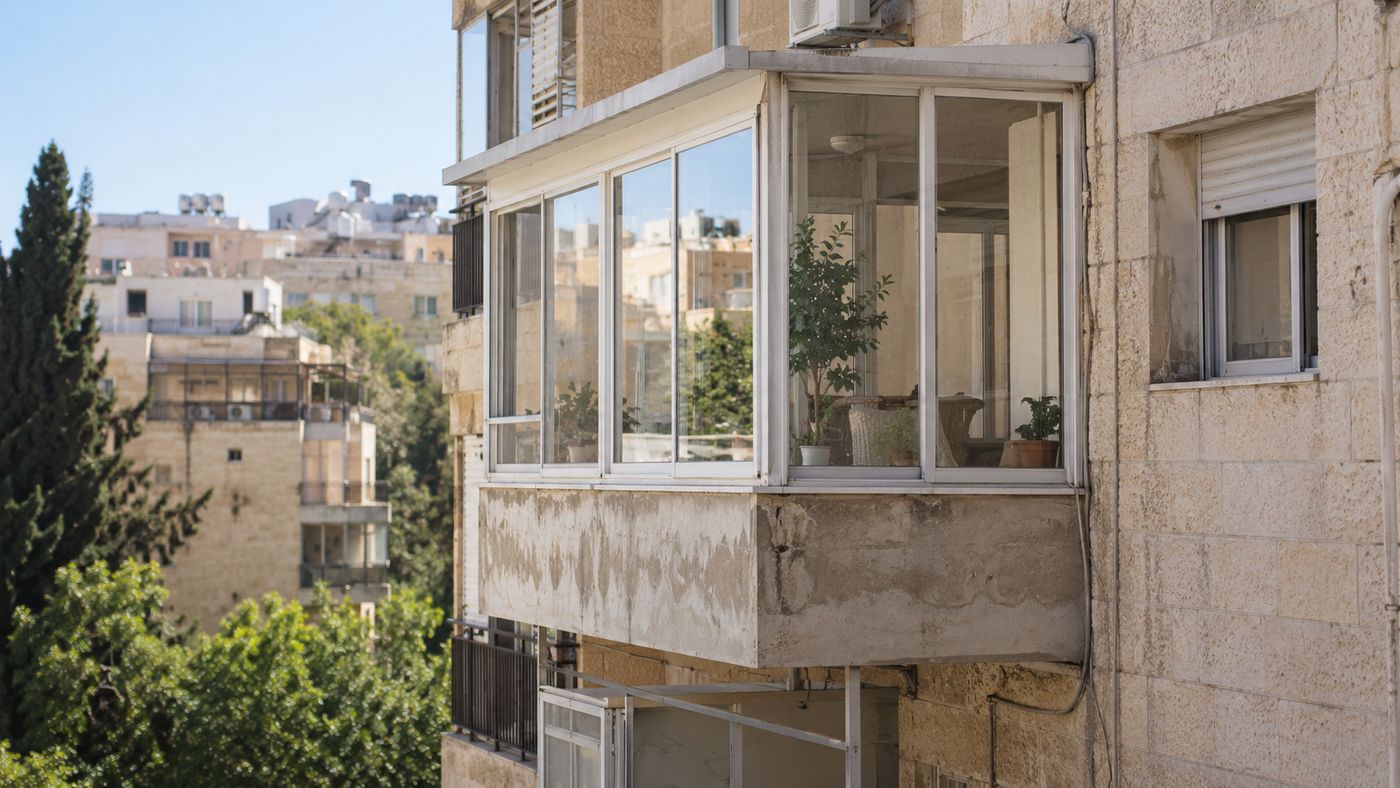
A man who put up a building without a permit asked the court to grant him a retroactive building permit and cancel the demolition order issued against the building. The Supreme Court dismissed his appeal, held there was no ground to interfere with the planning authorities' decisions, and ordered him to pay ILS 5,000 in costs.
What happened
The appellant built a two-storey stone and concrete building of about 250 square metres, without a permit, in the Hebron area of the West Bank. On 7.2.2018 he was served with a stop-work order, and about a week later, on 13.2.2018, he applied for a retroactive building permit to legalise the building.
On 16.1.2023 the Civil Administration's supervision subcommittee rejected the application on planning grounds: the applicant had only a partial connection to the land; the building had been put up without an approved detailed plan or parcellation plan; the number of storeys and the built area exceeded what the applicable plan allows; and the building was far from regulated built-up areas. Together with that decision he was served with a final stop-work and demolition order, and was given 30 days to restore the site himself.
His objection was rejected on similar grounds by the planning and licensing subcommittee in a decision of 12.4.2026, which gave him 14 more days to carry out the order himself. He then petitioned the Jerusalem District Court, which dismissed the petition outright on 26.5.2026. The District Court held that the decision rested on clear planning considerations and that the petition raised no specific argument against it. It also held that the petitioner had not come with clean hands: he had built without a permit and had even continued building and expanding after the stop-work order, so that the building now had three storeys and 370 square metres.
On 25.6.2026 an appeal was filed with the Supreme Court, together with a request to stay the demolition order until a decision. On the same day, the request for a temporary order was denied because of the delay in filing it.
The parties' arguments
The appellant argued that his petition should not have been dismissed outright, and that demolishing the building would violate his rights to property, to a roof over his head and to adequate housing, and would even breach international law. He therefore claimed that the decisions to demolish the building were unreasonable and made in bad faith.
The authorities argued that the appeal should be dismissed because the appellant had built without a permit and had expanded the building even after the stop-work order. In their view, the permit application had been rejected on planning grounds, the appellant had not addressed those grounds, and claims of harm to rights cannot legalise illegal construction.
The decision
The Supreme Court, sitting as a panel of three justices, dismissed the appeal on the basis of the written filings, under Regulation 138(a)(5) of the Civil Procedure Regulations, 5779-2018, which applies to administrative appeals by virtue of Regulation 34(a) of the Administrative Courts (Procedure) Regulations, 5761-2000.
The Court restated the rule that it does not substitute its own judgement for the professional discretion of the planning authorities. It interferes with such decisions only in exceptional cases, for example where the decision suffers from a fundamental flaw going to its root. According to the Court, this case was nowhere near that: the application had been rejected for clear planning reasons, and the appellant had not pointed to any flaw in the decisions or to any other recognised administrative ground for interference. The Court also made clear that claims of harm to the rights to property and housing do not legalise illegal construction.
The outcome
The appeal was dismissed, and with it the request for an interim order to stay the demolition. The appellant was ordered to pay the authorities ILS 5,000 in costs.
Key takeaways
- Do not start building before you have a permit: a retroactive permit application does not guarantee legalisation and will be judged on the usual planning criteria.
- If you receive a stop-work order, stop at once. Continuing and expanding the work can shut the court's door on you for lack of clean hands.
- If you want to stay a demolition order, act quickly. Delay in filing the request can lead to its rejection.
- When challenging a planning decision in a petition or appeal, address its reasons specifically. General arguments about the right to property or housing are not enough.
- Courts interfere with planning authorities' decisions only in exceptional cases, so it is important to build your case already at the application and objection stage before the authority.
This article summarizes a published Israeli court decision in plain language and is not legal advice. Every case depends on its facts. The parties' names have been omitted. This is a first-instance decision and may be appealed.